

The Hidden AI Divide: Small Businesses Risk Falling Behind as Larger Firms Report Higher Adoption

Natasha Broxton, founder and CEO of Select Auto Parts & Sales, at the Milwaukee business where she applies AI and automation to practical small-business operations.
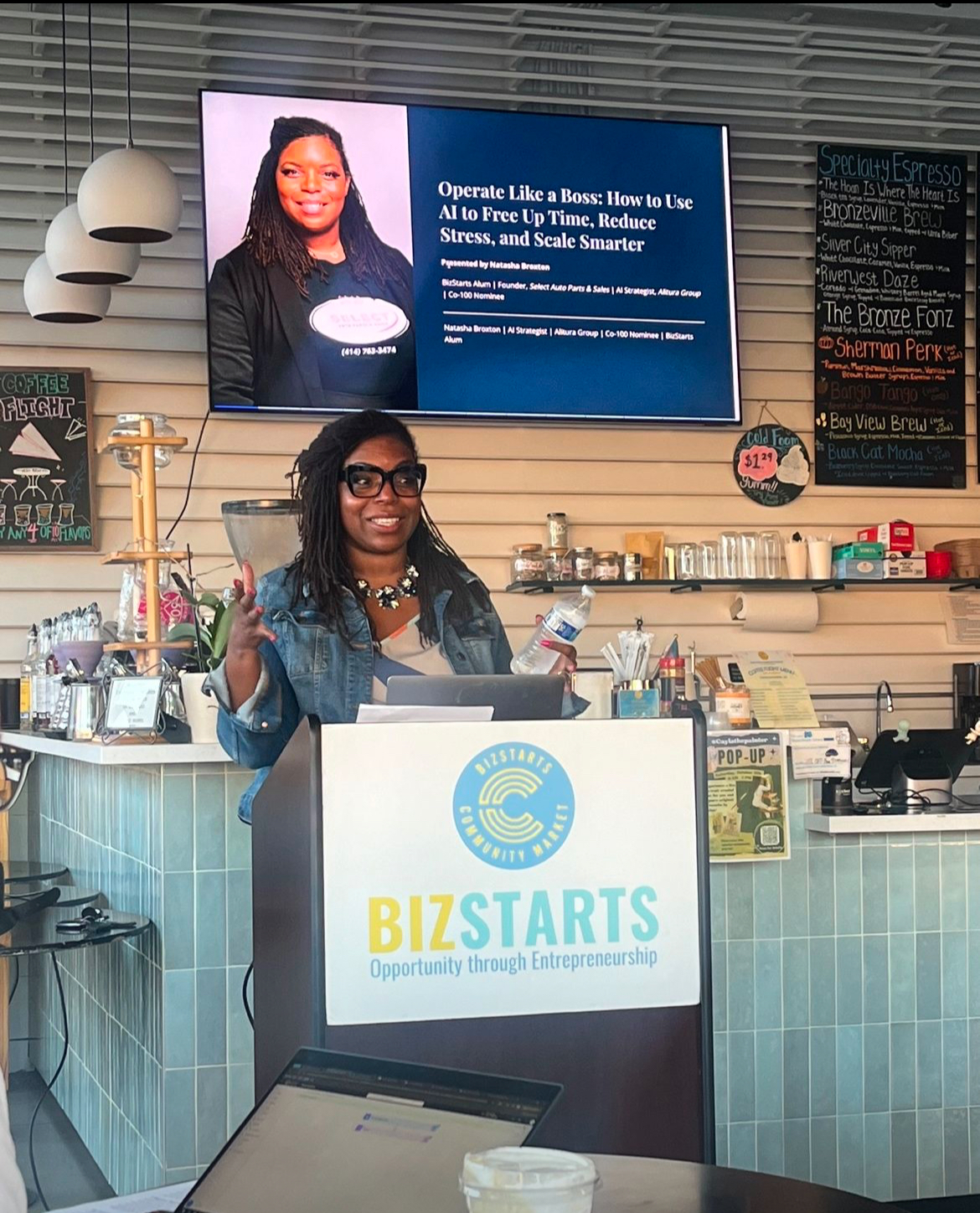
Natasha Broxton teaches business owners about practical artificial intelligence implementation during a BizStarts workshop in Milwaukee.

An employee works among organized used automotive parts at Select Auto Parts & Sales, illustrating the operational businesses affected by the small-business AI adoption gap.
Small firms power the U.S. economy, but federal data shows an AI adoption gap that could become a Main Street competitiveness issue.
The consequences could extend far beyond technology.
Small businesses represent 99.9 percent of U.S. businesses, employ 62.3 million people, or 45.9 percent of private sector workers, and account for 43.5 percent of the nation’s gross domestic product, according to the U.S. Small Business Administration Office of Advocacy.
As AI becomes increasingly useful for customer service, marketing, data analysis, administrative work, operations, and decision making, the ability to implement the technology could influence which businesses gain capacity and which struggle to keep pace.
U.S. Census Bureau data collected from December 2025 through May 2026 provides an early look at the difference by company size. Overall business AI use hovered between 17 percent and 20 percent during the period. Thirty seven percent of firms with at least 250 employees reported using AI in their business operations. AI use increased among firms with at least 20 employees but did not change significantly among businesses with fewer than 20 employees.
For Natasha Broxton, an entrepreneur who has spent more than a decade building and operating a Milwaukee automotive recycling company while implementing AI and automation inside its operations, those numbers point to a challenge often missing from the national AI conversation.
“The AI divide is not going to be between businesses that have heard of artificial intelligence and businesses that haven’t,” Broxton said. “It will be between companies that know how to turn AI into operating capacity and companies that don’t. For a small business already stretched thin, that difference matters.”
Broxton is founder and CEO of Select Auto Parts & Sales and founder of Alitura Group, where she teaches business leaders how to apply AI to practical business problems. Her experience has shown her that access to an AI tool is only the beginning.
A business owner may have access to ChatGPT or another AI platform and still lack the time to determine where AI belongs inside the company, which processes should be improved first, how existing information should be organized, what should remain under human control, and how employees should actually use the technology.
Unlike large corporations, many small companies do not have dedicated technology teams, data departments, automation specialists, or employees whose primary responsibility is experimenting with emerging technology. The same owner may be responsible for sales, hiring, finances, operations, customer problems, and strategy.
The issue, Broxton argues, is therefore not simply access to AI. It is access to the knowledge and capacity required to put it to work.
Federal Reserve analysis published in April 2026 also found a stronger association between AI adoption and firm size in recent business survey data. Researchers noted that adoption patterns vary by firm size and industry, reinforcing the importance of understanding who is using the technology as its economic role grows. The available data does not yet show whether AI related gains will accrue primarily to larger firms or help smaller businesses compete more effectively.
If larger companies gain the ability to respond to customers faster, analyze information more efficiently, reduce repetitive administrative work, and make decisions with better access to their own data, smaller competitors that lack implementation capacity could face disadvantages that compound over time.
That could affect which businesses win customers and contracts, which companies can afford to grow, and which remain locally owned. It also makes practical AI readiness an economic development issue.
Organizations that already support entrepreneurs, including chambers of commerce, small business development organizations, industry associations, workforce programs, lenders, municipalities, and community organizations, may increasingly need to consider practical AI education alongside traditional support such as access to capital, marketing assistance, and workforce development.
The goal, Broxton says, should not be turning every small business owner into a technology expert. It should be helping owners identify where technology can solve an actual business problem.
For some companies, that might mean improving how customer inquiries are captured and followed up. For others, it could mean organizing years of business information, making internal knowledge easier for employees to retrieve, reducing repetitive administrative work, analyzing customer patterns, or creating more consistent processes.
Small businesses already generate customer conversations, emails, estimates, photographs, inventory records, sales histories, service requests, schedules, documents, and years of institutional knowledge. The challenge is turning that information into usable business intelligence without requiring the resources of a large corporation.
“Small businesses have always had to do more with less,” Broxton said. “AI could become one of the greatest tools we’ve ever had to change that equation. But that only happens if business owners are taught how to use it in ways that actually improve the business. Access alone is not enough.”
As artificial intelligence becomes more deeply embedded in everyday business systems, the question facing Main Street may no longer be whether AI will affect small businesses. The question may be whether small businesses will have the resources, education, and implementation support necessary to benefit from it.
For interviews, keynote presentations, and executive workshops with Natasha Broxton, visit AlituraGroup.com/speaking.
About Natasha Broxton
Natasha Broxton is an award winning CEO, entrepreneur, speaker, and AI consultant who helps business leaders apply artificial intelligence to real business challenges. She is the founder and CEO of Select Auto Parts & Sales in Milwaukee and founder of Alitura Group. Her work focuses on practical AI implementation, operational improvement, business visibility, and helping leaders turn emerging technology into usable business systems.
Natasha Broxton
Alitura Group
+1 414-763-2475
email us here
Visit us on social media:
LinkedIn
Instagram
Facebook
YouTube
TikTok
Legal Disclaimer:
EIN Presswire provides this news content "as is" without warranty of any kind. We do not accept any responsibility or liability for the accuracy, content, images, videos, licenses, completeness, legality, or reliability of the information contained in this article. If you have any complaints or copyright issues related to this article, kindly contact the author above.
